
Choose your language >>>


Professional training for horse and rider — biomechanically sound, clearly structured, and focused on functional development.
The focus is on balance, clarity, suppleness, as well as precision and honest, understandable communication.
The goal is a responsive, well-balanced horse and a rider who can influence their horse consciously and with differentiation.
Mobile lessons, training, and clinics in Alberta.

All services are provided under Signum Equestrian.
Training Approach
Training is not about working through movements, but about the systematic development of function, balance, and responsiveness.
The foundation of all work is a horse that can move correctly, carry weight, and maintain self-carriage. Without this foundation, further training remains superficial.
Suppleness is not a goal in itself, but the result of clear aids, precise timing, and logically structured work.
Problems are not “corrected,” but analyzed at their root — in the movement pattern, in the communication, or in the structure of the training.
The goal is a horse that works with precision, responsiveness, and balance — and a system that remains understandable and reproducible for both horse and rider.
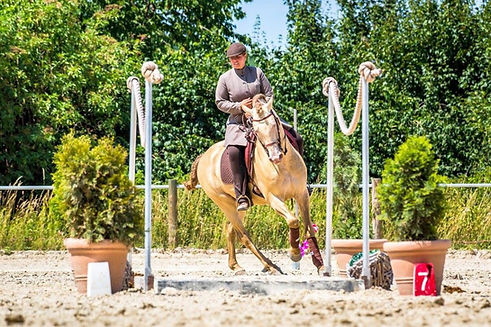

Services
Lessons and training are tailored individually and based on the current training level of both horse and rider.
The following are offered:
-
Private lessons
-
Small group lessons
-
Day clinics and workshops
-
Training rides and further development of horses
All work is carried out on-site.
Within a barn or region, appointments can be organized and combined.
The goal is structured, understandable training — independent of breed, riding style, or current performance level.
Anna Maurer
Professional Rider · Competitive Rider at International Level · Trainer
Behind Working Horse Training is Anna Maurer.
As a trained professional rider with over 25 years of experience in the training
of horses and riders, she stands for clear, functional, and sustainably
structured horsemanship.
Her training as well as her sporting career — including involvement in Working Equitation at an international level — form the foundation of her work. What matters, however, is not the title, but the consistent practical application over many years.
Her roots lie in classical English riding. At the same time, her education was shaped early on by an open perspective on different systems and riding styles.
This led her to gain practical experience in Western riding as well as in baroque training approaches — always with the goal of understanding connections rather than simply adopting methods.
From this development, her path consistently led to Working Equitation. This discipline combines dressage-based foundation work with practical application and places high demands on rideability, precision, composure, and the horse’s ability to take responsibility.
The discipline makes connections visible:
why dressage work is necessary, how it develops, and where it proves its value in practical use.
Over the years, she worked with trainers such as Pedro Torres (Portugal, trainer of the Portuguese national team, Working Equitation rider and trainer at international level), Manolo Oliva (Spain, former national coach Germany, trainer in classical dressage and Working Equitation), Rolf Janzen (Germany, trainer in Working Equitation and classical dressage), Britta Rasche-Merkt (Germany, trainer, instructor and current national coach Germany in Working Equitation), Thomas Thürmer (Germany, Working Equitation trainer and judge, European and World Championship participant).
These influences broadened her perspective and have sustainably accompanied her work without restricting it to a single system.
Several extended stays abroad also provided direct insight into working with horses outside of the pure training context.
Among other experiences, she spent time in Italy with the Butteri in Alberese (Tuscany), where she repeatedly worked as a rider at stallion performance tests of the Maremmano horses — the traditional working horses of Italian cattle herders.
These experiences in real working environments continue to shape her standards for functionality, reliability, and practical applicability in training.
She works with riders of different training levels — from ambitious leisure riders to riders with competitive goals. The individual situation always remains the focus: horse, rider, and their current level determine the training approach.
A particular focus lies on the development of already started horses. These are systematically advanced with the goal of making them physically capable, mentally stable, and precise and reliable in their response.
The aim is not to make a horse “function.” A horse that only obeys no longer provides information. This feedback, however, is essential for real progress.
The training aims to develop a horse that carries itself, can take on weight, and responds clearly and quickly to subtle aids — without suppressing tension or resistance.
The foundation for this is a deep understanding of movement patterns, timing, and influence. Mistakes are not viewed in isolation but analyzed within the overall system and solved systematically.
The work is characterized by clarity, consistency, and a high standard of precision — regardless of riding style or discipline.
This is what creates training that is understandable, reproducible, and sustainable in the long term.


.jpeg)



Contact & Inquiry
Requests for lessons, training rides, or clinics can be made directly via message.
To simplify planning, please briefly include:
-
Location
-
Number of horses / riders
-
Training level
-
desired scope (private lesson, group, clinic, training ride)
Appointments are arranged individually and — if possible — combined regionally.


Prices & Format
Sessions are structured depending on the training level of horse and rider:
– 40 minutes
– 60 minutes
– 90 minutes
Lessons, training rides, and clinics are designed individually.
Prices depend on scope, distance, and organizational effort.
For groups or barn appointments, coordinated conditions are possible.
Prices on request.

Working Horse Training is part of Signum Equestrian – operated by Signum Saddle & Tack Ltd.
Rebekka

I had the privilege of training with Anna for a while, and I learned an incredible amount from her. During this time, my horse Gaviota and I developed significantly and, thanks to Anna's support and excellent preparation, also became successful in working equitation competitions. I'm very sorry that she moved away.
Julia

As a student, I learned an incredible amount in riding lessons with Anna — far beyond what is usually understood as traditional riding instruction. With her, it was never just about how to give an aid, but above all why you give it and what it actually triggers in the horse.
Anna explained the connections of equine biomechanics to me from the ground up in a way that was easy to understand. She was able to show precisely why a horse moves the way it does, why certain reactions occur, and what is happening inside the horse’s body. Through this, I learned to truly understand my horse instead of merely reacting to symptoms.
What made her teaching especially valuable for me was her focus on me as a rider. Anna explained exceptionally well how my own body coordination, muscle tone, and breathing influence riding and individual movements. I learned how much my own body is part of the communication with the horse — often more so than any single aid.
I was particularly impressed by how vividly she taught. She could describe movements, sensations, and processes in such a way that you could actually feel them while riding. You didn’t just know what to do, but also how it should feel when done correctly.
This instruction has had a lasting impact on my riding. It gave me a deep understanding, a more refined body awareness, and an entirely new connection with my horse — and that is exactly what makes riding lessons with Anna so exceptional for me.
Franziska

Do you know that feeling? You hear instructions like “relax your pelvis” or “keep your hands quiet,” but you don’t really know how to put that into practice. That riding doesn’t just happen in your head, that you need to feel your horse’s movement with your whole body — that is something I only truly learned with Anna, after already having many years of experience in conventional riding lessons with their typical group riding. What did those years give me? The basics — and nothing more.
Anna helped me gradually build a real connection with my mare Paschmina. She stood by our side through many difficult phases, encouraged me not to give up, and helped me reach higher levels of horsemanship step by step. And she did this not through complicated theory, but through wonderfully vivid imagery.
When you imagine letting your energy flow into the ground as you transition down, breathing out deeply, or opening your chest when asking for canter as if the sun were shining out of it, your seat and your aids change intuitively. Anna gave me these images — and many more — and taught me that true riding is far more than a sport learned through training and technique alone. She showed me that real riding is not based on pressure or force, but on subtle aids and strong body awareness.
For me, Anna is the best trainer in the world — also because, with her, the horse’s well-being always comes first.
Rosalie

I learned as a student of Anna to always look at the horse as a whole, and that questioning things properly is essential.
Learning to ride is a lifelong process, and when a movement or exercise doesn’t work, there is always a reason for it.
That reason is never a lack of willingness on the horse’s part, but can have many different causes.
Unclear aids from the rider, unsuitable equipment, pressure (often subtle), or tension in the horse or the rider are just a few examples.
Anna taught me how to recognize these different causes.
I was fortunate to work with many different horses with Anna as my trainer.
Through this, I was able to learn from her how individual horse training truly is, and how important it is in riding to see the horse as a whole and to recognize the individual needs of each one.
She teaches knowledge with understanding — not rigid dogma, but holistic knowledge of horse and rider.
This creates harmony all the way into the higher movements,
and riding becomes an art.
Karin

I have worked with horses for many years — as the mother of a riding student and as the owner of a boarding stable. Over time, I repeatedly observed the same thing: when the combination of horse and rider does not function well, the cause is rarely the horse. In most cases, the issue sits above.The greater challenge is finding a trainer who recognizes that clearly — and is willing to address it.For my daughter, I searched for a long time for a riding instructor who truly sees horse and rider as one unit. We invested a great deal of money and were never completely satisfied. Real progress was hardly visible. By chance, we came across Anna — and from the very first lesson, the difference was clear. She sees the partnership. She quickly identifies the actual cause and works precisely where change is needed. From that point on, my daughter’s development became obvious.In my boarding stable, I had also seen typical issues: insecurity in riders, repeated falls, horses that would not move forward properly, tension within horse–rider combinations. That is why I organized a seminar weekend with Anna — eight different pairs, eight completely different problems. I was curious whether this could work.It did.Within a short time, Anna identified the individual challenges of each pair, named them clearly, and corrected them precisely. Improvement was visible and noticeable in most combinations very quickly. Not everyone finds her direct and honest style easy at first — but that clarity is exactly what makes it effective. One participant said after 30 minutes: “I’ve been working on this problem for nine months — today I finally understood it.”What continues to impress me is how often a small correction in the rider’s shoulder or pelvis can immediately change the horse’s movement. And when bigger issues arise, she will get on the horse herself and demonstrate that it can be done differently. Not through force — but through understanding and precision.A lesson with Anna means full concentration on horse and rider. Clear guidance, constructive corrections, praise when it is earned — and direct feedback when necessary. You leave the session mentally tired, but satisfied. The input continues to work for days afterward. Short video clips from the lesson are extremely helpful for reviewing and correcting later on.For my daughter, for my boarders, and for myself, working with Anna has been a true gain. Progress is visible — and understandable.
Lia

Training with Anna has had a lasting and positive impact on both my horse and me. Through her instruction, I didn’t just learn how to ride movements — I learned how and why they should be developed correctly. Her way of explaining aids is clear, structured, and easy to understand, which made it possible to apply them effectively and see real progress.
A central focus of Anna’s training is the gymnastic, horse-friendly development of the horse. Each session is thoughtfully built with the horse’s long-term soundness and well-being in mind, creating a solid foundation from which movements can be ridden correctly and fairly. This approach helped me better understand and communicate with my horse, recognize what support she needs, and train with greater responsibility and feel.
Anna combines extensive knowledge with a calm, empathetic approach toward both horse and rider. Her training is honest, systematic, and always centered on the horse — a coach I can wholeheartedly recommend.
Kathi

Where do I begin, and where do I end?
When I first saw Anna ride, I knew: That’s what I want, too.
From the very first lesson, it was clear — this kind of instruction is different. You learn on a deeper level, especially why a horse moves the way it does.
What fascinates me about Anna is how individually she works with both rider and horse. She explains everything in detail and truly goes into depth — always understanding and kind.
Through Anna, I learned how to ride using just thoughts, breathing, and weight aids — very close to the horse, yet light in the aids.
I can only recommend it to everyone.
This kind of instruction helps you understand what light riding can feel like. Only someone who understands their horse and knows what it needs will have a happy horse underneath them — one that would do anything for its person.
And that, for me, is good riding instruction.